

Reliable affordable internet for AI is quickly becoming the real bottleneck behind all the hype about generative models, copilots, and “AI for everyone.” Even as AI tools spread into classrooms, clinics, and public services, billions of people still lack the basic connectivity needed to use them in any meaningful way. That gap is turning yesterday’s digital divide into today’s AI divide, where access to bandwidth and low latency increasingly determines who benefits from intelligence at scale. The stakes are simple: if reliable, affordable internet does not catch up with AI, inequality will not just persist—it will compound.
Why Reliable, Affordable Internet Now Defines AI Access
AI workloads are bandwidth-hungry, latency-sensitive, and always-on, which means they depend on resilient, high-capacity networks rather than “good enough” connectivity. Real-time translation, adaptive learning platforms, and remote diagnostics all require stable broadband, not congested mobile plans with tight data caps.
“AI without robust connectivity is like a sports car on a dirt road—impressive on paper, but unusable for most people,” argues Dr. Lena Morales, AI infrastructure researcher at ETH Zurich. Reliable, affordable internet for AI is therefore not a luxury; it is a prerequisite for turning prototypes into everyday tools across education, healthcare, and government services.
From Digital Divide to AI Divide
Roughly 2.6 billion people remain offline, and many more are “under-connected” with slow, unreliable or capped access that cannot support modern AI applications. In low-income economies, an entry-level fixed broadband subscription can cost nearly one-third of average monthly income, effectively excluding large segments of the population from AI-enabled services.
Lead analyst Priya Nandur from the Global Digital Inclusion Initiative notes, “The conversation has shifted from ‘Are you online?’ to ‘Is your connection good enough to use AI safely and productively?’” When students cannot join AI-enhanced virtual classrooms or small businesses cannot tap cloud-based analytics, the AI divide hardens existing social and economic gaps.
Infrastructure, Latency, and the New Performance Baseline
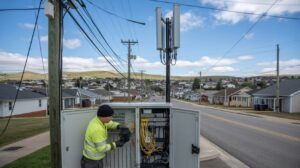
High-quality AI experiences demand low latency, high throughput, and reliability that legacy DSL or congested 3G networks simply cannot deliver. Fiber optic networks, modern 5G deployments, and next-generation satellite constellations are emerging as the backbone of AI-era connectivity, enabling multi-gigabit speeds and real-time processing at scale.
The World Economic Forum’s Edison Alliance stresses that resilient digital infrastructure is now central to handling the data flows and real-time analytics that AI depends on. “If policymakers treat broadband as yesterday’s issue while chasing AI headlines, they are guaranteeing a brittle, unequal intelligent economy,” warns Dr. Marcus Yao, digital policy fellow at the World Economic Forum.
Affordability: The Quiet AI Adoption Killer
Even where networks exist, pricing still locks millions out of AI-heavy services. The ITU reports that while broadband baskets have become more affordable on average, users in low-income economies pay up to 19 times more of their income for mobile broadband than users in high‑income economies.
Similarly, regional data show that Africa has the least affordable fixed broadband, with a basic 5 GB plan costing around 13 percent of GNI per capita, compared with far lower shares in Europe and Asia-Pacific. “We talk about ‘AI for the global majority’ while pricing connectivity like a luxury good in many markets,” says Jochai Ben-Avie, CEO of Connect Humanity. Without aggressive efforts to cut data prices, expand competition, and support low-income users, AI adoption will remain an elite story.
Policy, Industry, and AI Design: What Must Change
Governments, telecom operators, and AI companies each control a piece of the solution. Public programs that fund fiber, last-mile wireless, and rural backhaul—paired with clear affordability targets—can rapidly expand meaningful connectivity, especially when combined with AI-optimized planning that reduces network buildout costs by 5–15 percent.
On the industry side, AI developers need to design models and interfaces that tolerate lower bandwidth, run efficiently on edge or on-device hardware where possible, and support local languages on low-cost smartphones. For publishers and SaaS builders, that also means offering “lite” modes, offline caching, and bandwidth-aware experiences that still deliver value over weaker connections.
Key Takeaways
-
Reliable affordable internet for AI is now the true limiting factor for inclusive AI adoption, not algorithms or cloud capacity.
-
The digital divide is rapidly becoming an AI divide, especially for students, small businesses, and rural communities.
-
Fiber, 5G, and new satellite systems form the technical backbone, but affordability determines who can actually participate.
-
Smart policies, AI-optimized network planning, and bandwidth-aware product design can cut costs and expand meaningful connectivity.
-
Without urgent action, AI will scale inequality instead of opportunity, particularly across low-income and underserved regions.
Related Article (Also Read)
SPEED Act and AI Infrastructure: Will Permitting Reform Supercharge U.S. Innovation?
References
-
Georgetown Law Tech Institute – Bridging the Digital Divide as We Build the Digital Future: https://www.law.georgetown.edu/tech-institute/insights/bridging-the-digital-divide-as-we-build-the-digital-future/
-
Global Digital Inclusion – AI for the Global Majority: The Digital Divide No One’s Talking About: https://globaldigitalinclusion.org/2025/02/21/ai-for-the-global-majority-the-digital-divide-no-ones-talking-about/
-
World Economic Forum – Entering the Intelligent Age without a digital divide: https://www.weforum.org/stories/2024/09/intelligent-age-ai-edison-alliance-digital-divide/
-
ITU – Facts and Figures 2024: Affordability of ICT Services: https://www.itu.int/itu-d/reports/statistics/2024/11/10/ff24-affordability-of-ict-services/
-
Statista – Global Fixed Broadband Affordability by Region 2024: https://www.statista.com/statistics/1475097/global-fixed-broadband-affordability-by-region/
-
Connect Humanity / CFR – Don’t Let AI Become the Newest Digital Divide: https://www.cfr.org/blog/dont-let-ai-become-newest-digital-divide
-
Internet Society – Exploring the Global State of Internet Poverty in 2024: https://pulse.internetsociety.org/blog/exploring-the-global-state-of-internet-poverty-in-2024