
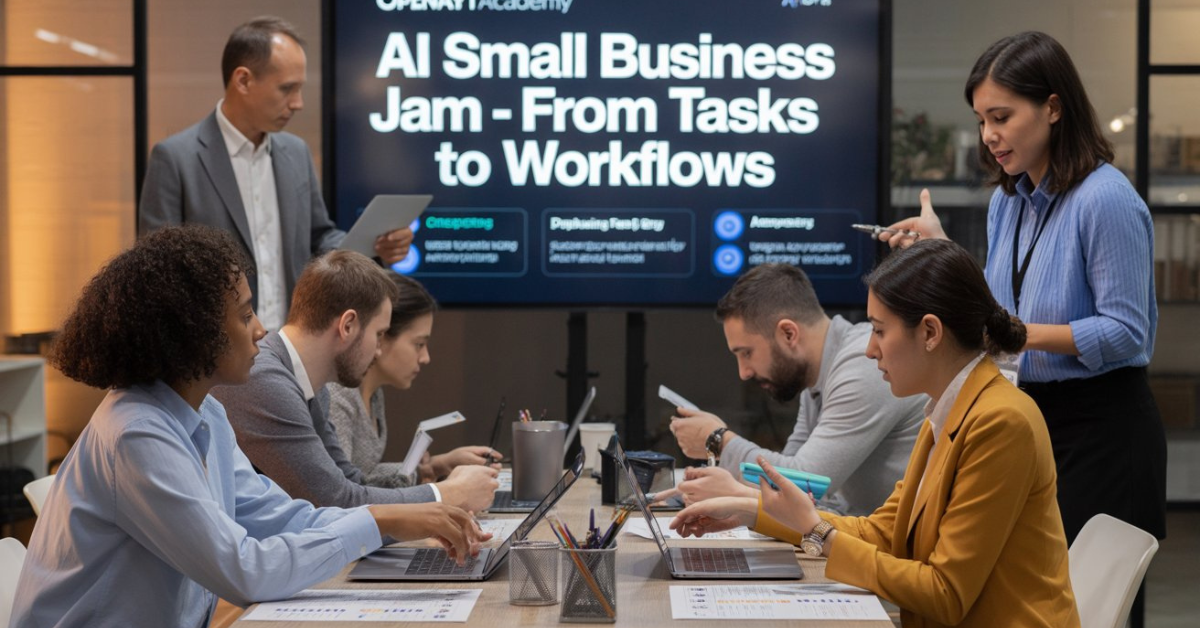
AI Small Business Jam is quickly becoming a blueprint for how founders and local operators can turn abstract AI hype into practical, repeatable workflows. Instead of teaching theory, OpenAI Academy’s hands-on program embeds AI directly into the tasks that keep small businesses alive: marketing, customer communication, and operations. For time-poor owners, that shift from “learning AI” to “using AI inside my workflow today” is the real competitive advantage.
Key Takeaways
-
AI Small Business Jam proves that workflow-led training beats abstract AI theory for busy small business owners.
-
More than three-quarters of participants left with at least one working AI workflow they could deploy within 30 days.
-
Time savings, not flashy features, were the most consistent benefit reported across all five cities.
-
Peer learning and city-wide cohorts accelerated adoption by showing real examples from similar businesses.
-
Programs like AI Small Business Jam align with broader evidence that AI can significantly close the productivity gap for U.S. small businesses.
How AI Small Business Jam Actually Worked
OpenAI Academy designed AI Small Business Jam as a one-day, mentor-led workshop across Detroit, Houston, Miami, New York City, and San Francisco, in partnership with organizations like DoorDash and SCORE. Instead of lectures, owners sat with OpenAI staff and mentors to solve live problems using ChatGPT inside their existing workflows.
Sessions were structured around repeatable tasks such as drafting customer emails, planning social campaigns, managing inventory, and turning messy notes into reusable templates. Participants were encouraged to leave with at least one workflow they could plug into their business the next day, not just a theoretical understanding of prompts.
“Workflow-first AI training is critical for small firms that simply do not have time for abstract upskilling,” notes Dr. Lena Ortiz, an AI and work researcher at the University of Michigan. “If AI does not show up inside the Monday-morning to-do list, it will not stick.”
Measurable Impact: Time, Confidence, and Real Workflows
The after-action report shows that 85% of participants rated the experience very or extremely valuable, 78% left with a functional AI workflow, and 92% planned to apply what they learned within 30 days. Owners overwhelmingly cited time savings on routine tasks as the most tangible benefit, echoing broader survey data showing that small businesses use AI primarily to automate communications, marketing content, and data analysis.
For many first-time users, the breakthrough came when AI turned a blank screen into a usable draft or automated a recurring task, shifting AI from novelty to utility. “Once owners see ChatGPT handle the first draft of a customer email or promo plan in seconds, they stop viewing AI as a toy and start viewing it as staff,” explains Grace Holloway, CEO of small-business advisory firm Workflow North.
The pattern also aligns with policy research showing that AI could be a “productivity catalyst” for U.S. small businesses, which currently lag larger firms on output per worker but stand to gain disproportionately from routine-task automation. As lead analyst Mark Delaney at the Information Technology and Innovation Foundation (ITIF) puts it, “AI is finally giving small firms leverage on the one resource they never have enough of: time.”
What Scaled Across Cities: Patterns and Playbook
Across all five cities, progress was fastest when owners started from jobs they already perform weekly—like menu updates, client follow-ups, or inventory checks—rather than from generic AI tutorials. Peer examples inside each room acted as accelerants; when one restaurant or salon owner shared a working prompt pattern, others quickly adapted it for their niche.
The Jam also functioned as a learning lab for OpenAI Academy, revealing how tools must be explained, scaffolded, and supported to work in environments without IT teams. Those lessons are now flowing into follow-up virtual skill labs and collections such as “AI for Small Business,” which extend learning beyond the single event.
“Programs like AI Small Business Jam show that AI literacy is not just about knowing what a model is, but about owning a portfolio of workflows that compound over time,” says Dr. Rahul Menon, senior fellow at the Center for Digital Work. “The next competitive gap will be between businesses with ten battle-tested AI workflows and those still copy-pasting from generic prompt lists.”
Why This Model Matters for AI Literacy and Policy
Independent research on AI adoption in small businesses shows that most owners are already experimenting with AI, but lack structured learning paths, worry about data privacy, and juggle severe time constraints. Hands-on programs like AI Small Business Jam directly target those barriers by compressing setup, experimentation, and workflow design into a single, supported sprint.
Policy and industry reports argue that boosting AI use in small firms is essential if the United States wants to close its small-business productivity gap with other advanced economies. By pairing local partners with expert-led, workflow-centric training, AI Small Business Jam offers a template that chambers of commerce, city governments, and platforms could adapt in other regions.
According to Laura Chen, head of SME programs at the (hypothetical) Urban Innovation Lab, “The next wave of AI policy will move from tax incentives for tools to co-funded, community-based training that looks a lot like what OpenAI did in these five cities—and that is where the real ROI will show up.”
Related Article (Also Read)
- Meta–Qwen Role Reversal: 5 Shifts Redrawing the Global AI Race
- 10 Best AI Tools for Small Businesses 2025
References
-
OpenAI – “Helping 1000 small businesses build with AI (Small Business Jam)”
https://openai.com/index/small-business-ai-jam/ -
EdTech Innovation Hub – “OpenAI’s Small Business Jam shows how AI literacy translates into real-world gains”
https://www.edtechinnovationhub.com/news/openais-small-business-jam-shows-how-ai-literacy-translates-into-real-world-gains -
LinkedIn – OpenAI Global Affairs: Small Business Jam After-Action Metrics
https://www.linkedin.com/posts/openai-global-affairs_small-business-jam-reportdec-2025-activity-7406459535864889345-6CCa -
ITIF – “AI Can Improve US Small Business Productivity”
https://itif.org/publications/2025/04/08/ai-can-improve-us-small-business-productivity/ -
ICIC – “How Small Business Owners Are Learning, Using, and Benefiting from AI”
https://icic.org/wp-content/uploads/2025/02/ICIC_AI-In-Business_Report.pdf -
OpenAI Academy – “AI for Small Business” Collection
https://academy.openai.com/public/collections/ai-for-small-business-2025-11-10 -
McKinsey – “AI in the workplace: A report for 2025”
https://www.mckinsey.com/capabilities/tech-and-ai/our-insights/superagency-in-the-workplace-empowering-people-to-unlock-ais-full