
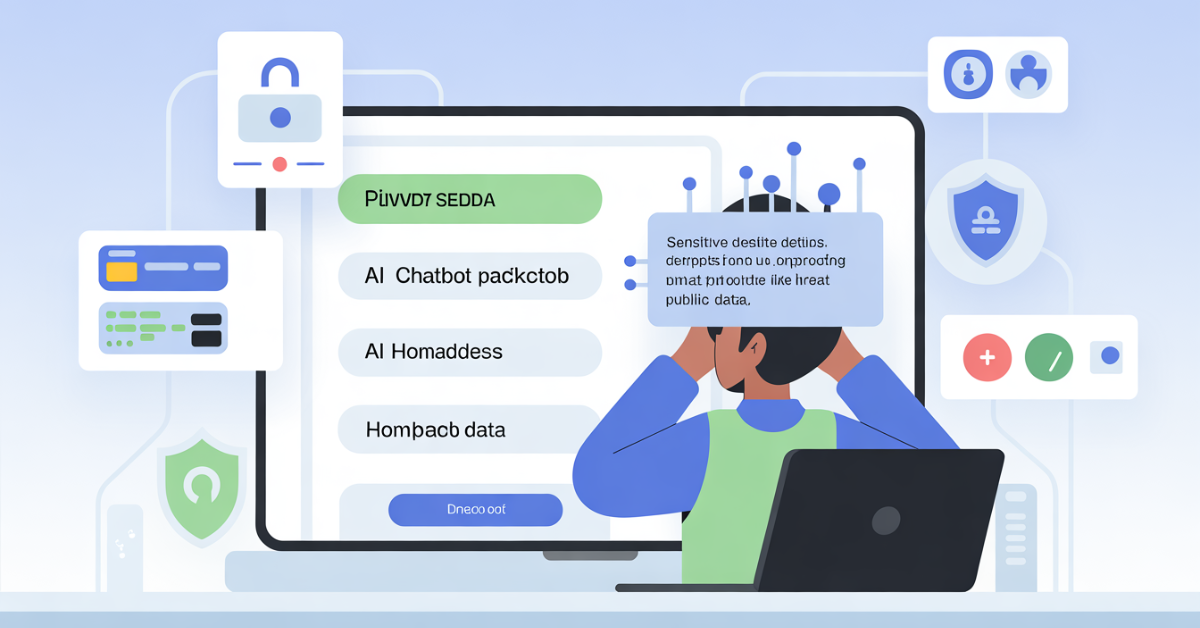
AI chatbot privacy risks are no longer theoretical—they are baked into how modern models learn from your data. As AI tools move into everyday work and life, sensitive prompts can quietly become training material, telemetry, or even breach fallout. That is why security engineers now tell people to treat public chatbots more like social media broadcasts than private diaries. Understanding how different platforms handle your conversations is now a core cybersecurity skill, not a niche concern.
Key Takeaways
-
Treat public AI chatbots as “public postcards,” never as secure vaults for secrets.
-
Use enterprise-grade AI with contracts and admin controls for anything involving confidential work data.
-
Regularly clear chat history, review privacy toggles, and disable training where possible.
-
Some platforms (like Le Chat and ChatGPT) offer stronger privacy controls than others such as Meta AI, Gemini, and Copilot.
-
Build a simple internal policy: what staff can and cannot paste into any AI tool.
Understanding AI chatbot privacy risks
AI chatbot privacy risks stem from one core reality: most public models rely on user data for improvement, logging prompts, metadata, and sometimes account identifiers. A Stanford-led study this year found that users consistently underestimate how long their AI chats may persist and how easily they can be linked back to them.
“People assume that conversational interfaces behave like forgetful humans, but technically they behave more like append-only logs,” notes Dr. Jennifer King, a privacy researcher at Stanford University. This gap between human intuition and machine logging is exactly where cybercriminals, data brokers, and overly intrusive platforms exploit users.
Google expert’s 4 safe-chat rules
Google security engineer Harsh Varshney advises users to treat AI chatbot privacy risks the same way they treat posting on a semi-public forum. His core guidance: never share Social Security numbers, payment data, home addresses, or health records with public chatbots, because those details might be retained or reused.
Varshney also recommends using enterprise AI for sensitive work, routinely deleting conversation history, and enabling “incognito” or no-training modes when available. “If you would be uncomfortable seeing a screenshot of that prompt in a breach notification email, it does not belong in a consumer AI chat window,” says Varshney.
Which AI platforms handle privacy better?
Independent research from Incogni ranked popular AI platforms on data collection, transparency, user controls, and model-training policies, directly exposing uneven AI chatbot privacy risks. Mistral AI’s Le Chat scored best overall for privacy because it collects less data and offers clear controls to limit training, while ChatGPT and Grok followed with relatively strong but more data-hungry approaches.
By contrast, Meta AI, Google’s Gemini, and Microsoft’s Copilot were flagged as significantly more aggressive in data collection and less transparent about secondary use, especially for marketing and model improvement. “The spread between the safest and most invasive AI chat tools is wide enough that platform choice now matters as much as password strength,” argues Lina Morales, lead analyst at digital rights group Data Watch Labs.
Privacy posture of major AI chatbots
| Platform | Privacy posture on user data* | Key user controls | Noted issues |
|---|---|---|---|
| Le Chat (Mistral) | Light data collection, stronger limits on training use | Options to restrict training, minimal telemetry | Moderate transparency language; fewer ecosystem integrations |
| ChatGPT | Clearer policies, but broad data collection for training and safety | Training opt-outs, workspace controls in paid plans | Extensive logs; enterprise controls vary by plan |
| Grok | Competitive privacy score with reasonable controls | Some limits on model training and sharing | Policy language still evolving, especially around third parties |
| Meta AI | Highly intrusive data collection including location and app data | Limited training opt-out, complex settings | Profiling risk across Meta’s ad ecosystem |
| Gemini | Wide data collection and unclear retention defaults | Account-level toggles for training and history | Tighter integration with Google account data |
| Copilot | Strong capabilities but intrusive telemetry for personalization | Some enterprise controls via Microsoft 365 | Mixed transparency around cross-product sharing |
Practical rules to reduce AI chatbot privacy risks
For individuals, the first rule is simple: assume every public chatbot message is permanently stored and potentially reviewable. Keep anything regulated, contract-bound, or reputationally sensitive out of consumer tools and into vetted enterprise AI with signed data-processing agreements.
Second, aggressively use privacy controls: disable training where allowed, delete old threads, and log out on shared devices. “Security teams should publish a two-column list: ‘Safe to paste’ and ‘Never paste’ into AI tools, and train staff against that list quarterly,” recommends Dr. Asha Nair, an AI security lecturer at University College London.
Enterprise strategies for safer AI usage
Organizations face amplified AI chatbot privacy risks because employees often paste source code, customer lists, or contracts into whatever chatbot is easiest to open. The answer is not to ban AI, but to provide a sanctioned enterprise AI environment with logging, access control, and clear boundaries.
Companies should:
-
Standardize on one or two enterprise AI providers with strong contractual privacy protections.
-
Enforce single sign-on, role-based access, and data loss prevention integrations around AI tools.
-
Run regular tabletop exercises simulating a prompt-history leak to test incident response.
“Forward-looking CISOs are treating generative AI not as a toy, but as a new data egress channel that must sit inside the same governance envelope as email and cloud storage,” says Marco Leone, cybersecurity director at EuroSec Institute.
How to choose safer AI platforms
When deciding which AI chatbot privacy risks to accept, look beyond model quality and compare privacy dashboards, training opt-outs, and regional data hosting options. Favor providers that minimize data collection, document retention periods, and support region-specific storage for compliance.
Before adopting any AI platform, read its privacy section on model training, third-party sharing, and security certifications. If the provider cannot clearly explain how your prompts are stored, used, and deleted, assume the answer is “in ways you would not want sensitive data to be used.
Also Read (Related Post)
Google DeepMind Unveils New Benchmark to Tackle LLM Hallucinations
References
-
https://www.businessinsider.com/google-ai-security-safe-habits-privacy-data-2025-12
-
https://www.webpronews.com/google-experts-4-rules-for-safe-ai-use-and-privacy-protection/
-
https://www.netfriends.com/blog-posts/5-data-privacy-best-practices-for-ai-users
-
https://dialzara.com/blog/ai-chatbot-privacy-data-security-best-practices
-
https://news.stanford.edu/stories/2025/10/ai-chatbot-privacy-concerns-risks-research